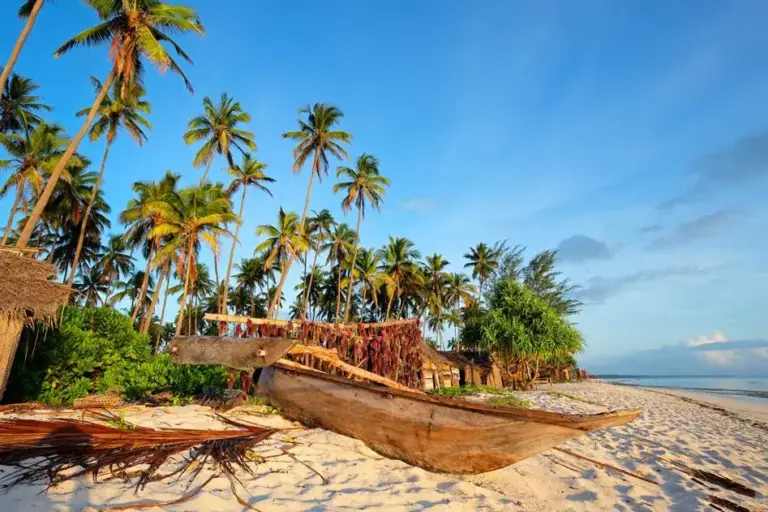

For a traveller heading to the Kenyan coast, an hour or two here is the best way to grasp why the coast is so different from the safari parks inland: it is a place of trade, of many languages and of centuries of contact between Africa, Arabia, India and Europe.
Building the fort
The fort was built between 1593 and 1596 on the orders of King Philip II of Spain, who also ruled Portugal as Philip I, to protect Portuguese trade and to provide a permanent base on the Swahili coast. It was designed by the Italian military architect Giovanni Battista Cairati, whose work appears across Portugal’s eastern possessions from Goa to Mombasa. Fort Jesus was his last overseas project. It is a classic of Renaissance military design: roughly square, with four corner bastions, and laid out according to the belief that perfect proportions could be found in the human body. Seen from the air, the plan is said to resemble a man.
Although the design was European, the labour, the masonry and the materials were provided largely by local Swahili builders, and Swahili touches, such as plastered wall niches, can still be seen.
A fortress that changed hands
Ironically, the fort marked the beginning of the end of Portuguese dominance on this coast. In the seventeenth century Omani Arabs began to raid Portuguese holdings, and in 1696 they besieged Fort Jesus for a long time before driving the Portuguese out. After that the fort changed hands repeatedly between Omanis, local Swahili rulers and briefly the Portuguese again, at least nine times between 1631 and the nineteenth century. In the 1890s, after the East Africa Protectorate was created, it passed to the British, who used it as a prison. It later became a museum, and in 2011 UNESCO recognised it as an outstanding example of sixteenth-century Portuguese military fortification.
What you will see
- The walls and bastions: thick coral-stone walls, with cannon and a moat, and wide views from the battlements over the old harbour and the Indian Ocean.
- Layers of history: rooms that show Portuguese, Omani and British alterations. The Mazrui Hall, named for the Omani-linked family that ruled Mombasa, has decorated walls and wooden lintels.
- Graffiti of ships: old carvings by sailors depict European ships, Arab dhows and the Swahili mtepe, a sailing vessel sewn together with coconut-fibre rope.
- The museum: collections of Swahili, Omani, Portuguese and Chinese ceramics, coins, and artefacts recovered from the wreck of a Portuguese ship, the Santo Antonio de Tanna, that sank off Mombasa in 1697.
- The gardens and courtyard: shaded grounds where you can rest and reflect.
Most visitors spend one to two hours. A local guide adds enormously to the visit. Evening sound-and-light or storytelling events are sometimes held. Ask.
Around the fort: Mombasa Old Town
Fort Jesus faces the old part of Mombasa, a tangle of narrow lanes lined with carved wooden doors, Swahili houses, small mosques and spice sellers. A walk through the Old Town, a visit to the Hindu temples and the Mandhry Mosque, and a bite of coastal food such as mishkaki or samosa make a fine half-day. The lively Mombasa waterfront is close by.
Practical information
- Location: Mombasa Island, at the entrance to the Old Port.
- Time needed: one to two hours for the fort; a half-day with the Old Town.
- Best time: morning, when the heat is lower, though the coast is warm and humid all year. The long rains (about April to June) can bring heavy showers.
- Dress: comfortable shoes, a hat and modest clothing for the Old Town’s mosques.
- Getting there: Mombasa is about an hour by air from Nairobi, roughly five hours on the Standard Gauge Railway, or a long day’s drive. Fort Jesus is close to the centre.
- Fees and hours: confirmed by us before your visit.
Fort Jesus with Offmap Safaris
We add Fort Jesus and Mombasa Old Town to coastal itineraries, together with Diani, Watamu, Gedi and Lamu. Plan your safari, message us on WhatsApp +256 701 243 304 or email [email protected]. See our Visa & Entry Requirements for Kenya’s eTA.
Plan a safari that includes Fort Jesus
Our team plans private, tailor-made safaris, so we can build a trip around Fort Jesus and adjust the days, lodges and pace to suit you.