The setting is a green, peaceful hillside of banana groves and thatched buildings. The pace is unhurried, the crowds are absent and the guides are often members of families who have looked after the tomb for generations.
Kabaka Suuna II
Suuna II ruled Buganda from about 1832 to 1856 and was the father of the famous Kabaka Mutesa I. He is remembered as a powerful and energetic king, and his reign was a period of growth and consolidation for the kingdom. As tradition required, his palace became his tomb after his death. That palace, at Wamala, is one of only two royal tomb complexes of its kind that survive in Uganda.
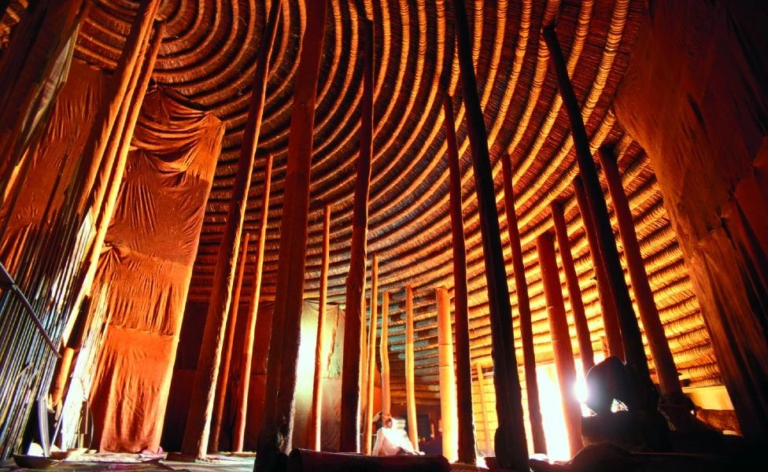
The building that houses the tomb is a large thatched structure of wooden poles, reeds and thatch, similar in form to the main house at Kasubi. Its interior, curtained with bark cloth, is guarded by custodians who follow traditional customs, including those relating to the spiritual “forest” that lies beyond the tomb.

How Buganda buries its kings
The Kasubi and Wamala Tombs, together, represent a tradition in which the palace of each king became his burial place. The king is understood not to die but to go into the forest, and the tomb preserves his presence as a guardian of the kingdom. The structures are made of renewable materials and must be maintained and rethatched continually by craftspeople of the kingdom’s clans, each of which has a defined responsibility. The care of the tombs is therefore a living act of cultural transmission.
Traditionally, the jawbone of a deceased Kabaka was believed to hold his spirit and was kept in a separate shrine. Guides explain these customs with the care they deserve.
What a visit is like
- You are met by a custodian or guide, who tells the story of Suuna II, the palace and the customs of the tomb.
- You are shown the exterior of the thatched house, the compound, the courtyard and the surroundings.
- Where allowed, you enter the tomb house, after removing shoes, and are shown the barkcloth curtain and the entrance to “the forest”, which it is taboo to look beyond.
- You have time to ask questions, and to sit and take in the atmosphere.
A visit takes about an hour. Because it is a working shrine, access to some areas is restricted, and a small fee is usually charged. We confirm details before you go.
Wamala and Kasubi compared
If you have time for only one, choose Kasubi for its scale, its UNESCO status and its central location in Kampala. If you have time for both, Wamala adds a great deal: it is older, quieter and set in the countryside, and it shows that the tradition is not confined to a single monument. Many visitors say that Wamala feels more intimate, and that the guides have more time to talk.
Etiquette
- Dress modestly, and remove shoes where asked.
- Photography is often restricted, particularly inside the tomb house.
- Follow the custodians’ instructions about where to walk and where not to look.
- A small gift or donation to the custodians is appreciated, and your guide can advise on what is appropriate.
Practical information
- Location: near Nsangi in Wakiso District, west of Kampala on the road towards Masaka. Allow up to an hour from central Kampala, depending on traffic.
- Time needed: one to two hours, or a half-day when combined with Naggalabi Buddo.
- Best time: mornings, and dry days when the road is easy.
- Getting there: a private vehicle and guide are the simplest option.
Making a heritage day
Wamala works best in a full Buganda day: the Kasubi Tombs in the morning, then west to Wamala and Naggalabi Buddo, with lunch on the way. The route also links neatly to the road to Masaka and the Ssese Islands via Bukakata, so a heritage day can continue into a lakeside stay.
Visit Wamala with Offmap Safaris
We build Wamala into Buganda heritage days and longer cultural safaris. Plan your safari, message us on WhatsApp +256 701 243 304 or email [email protected]. Please also read our Responsible Travel page.
Plan a safari that includes Wamala Tombs
Our team plans private, tailor-made safaris, so we can build a trip around Wamala Tombs and adjust the days, lodges and pace to suit you.