
Mountain gorillas
Found only in Bwindi Impenetrable and Mgahinga (Uganda) and Volcanoes National Park (Rwanda). See our dedicated Mountain Gorillas page.
Chimpanzees
Best tracked in Uganda’s Kibale National Park, Kyambura Gorge and Budongo Forest, and Rwanda’s Nyungwe National Park. See our dedicated Chimpanzees page.
Golden monkeys
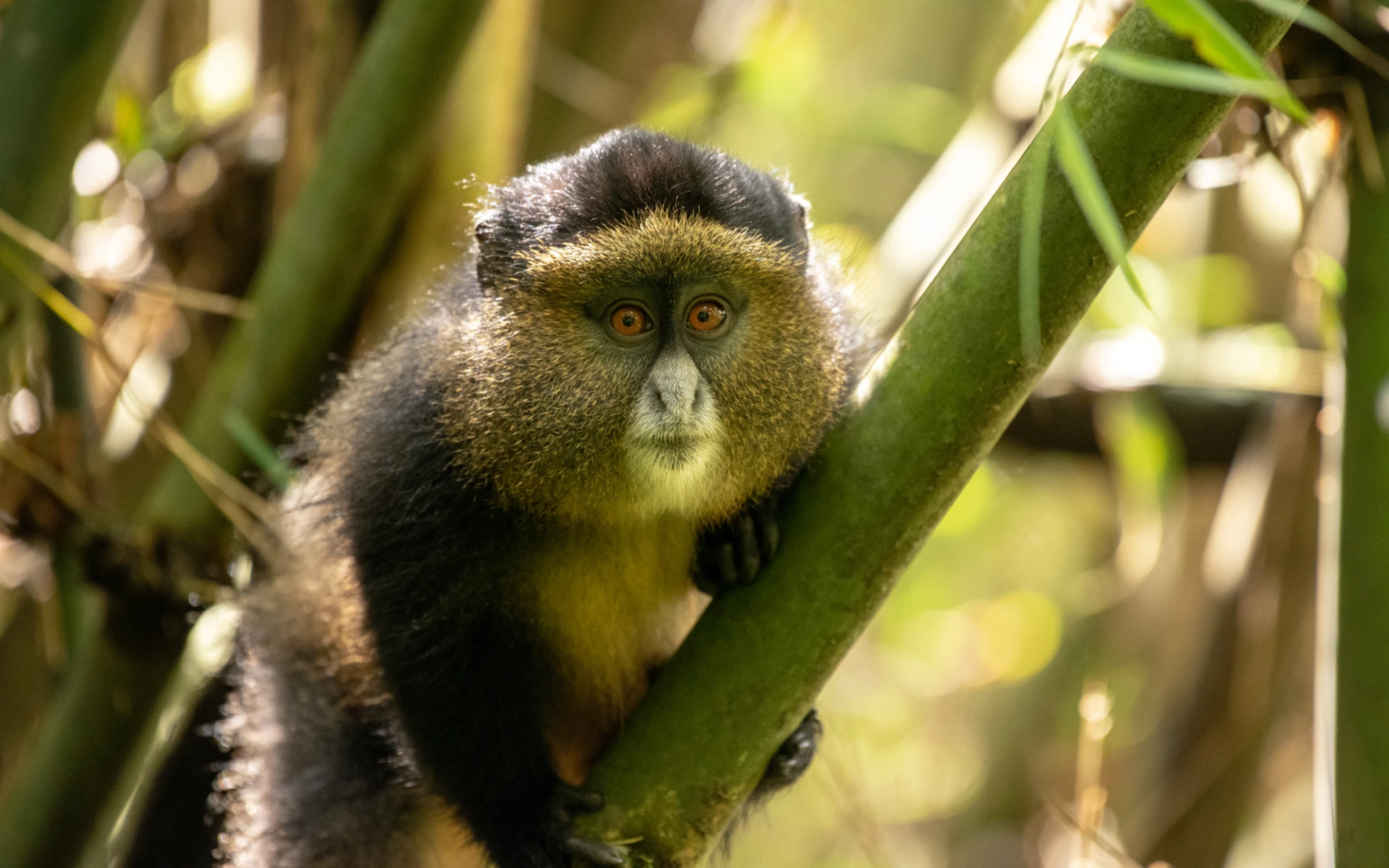
An endangered, strikingly orange-gold primate found almost exclusively in the bamboo zones of the Virunga volcanoes: tracked in Rwanda’s Volcanoes National Park and Uganda’s Mgahinga Gorilla National Park, usually as a shorter, easier add-on activity alongside gorilla trekking.
Black-and-white colobus monkeys
Striking, long-tailed forest monkeys seen regularly in Kibale, Nyungwe, Bwindi and the forests around Lake Bunyonyi: among the most photogenic primates in the region thanks to their flowing white mantle and tail, often spotted leaping between canopy gaps.
L’Hoest’s, red-tailed and blue monkeys
Smaller forest monkey species found throughout Bwindi, Kibale and Nyungwe, often seen in mixed troops and regularly encountered on forest walks even outside a dedicated primate trek.
Baboons and vervet monkeys
The region’s most widespread primates, found in savanna parks across all four countries (Queen Elizabeth, Murchison Falls, Lake Mburo, Akagera, the Serengeti, Maasai Mara and beyond) and a near-certain sighting on any game drive rather than requiring a dedicated trek.
Build a primate-focused safari
Gorillas, chimpanzees, golden monkeys and forest walks for the smaller species can be combined into a single, genuinely primate-heavy itinerary. Visit Plan My African Safari, message us on WhatsApp at +256 701 243 304, or email [email protected].
Primates of East Africa at a glance
East Africa is one of the best regions on Earth for primates. The great apes are the stars: mountain gorillas and chimpanzees. Around them live monkeys that are easy to enjoy, from the golden monkeys of the Virunga volcanoes to black-and-white colobus, blue monkeys, red-tailed monkeys, L'Hoest's monkeys and baboons. Together they make a primate safari one of the most varied wildlife experiences you can plan.
Best primate safari countries
Uganda is the headline primate country, with gorillas in Bwindi and Mgahinga, chimpanzees in Kibale, Budongo and Kyambura and a dozen or more monkey species. Rwanda is compact and excellent, with gorillas and golden monkeys in Volcanoes and chimpanzees and colobus in Nyungwe, which holds around a dozen primate species. Tanzania adds chimpanzees at Gombe and Mahale and many monkey species in forests and savanna parks. Read our guides to mountain gorillas, chimpanzees and golden monkeys.
A sample primate safari
A typical eight to ten day primate safari combines gorillas in Bwindi, chimpanzees in Kibale and a day of golden monkeys or hiking at Mgahinga or Volcanoes. It can add a savanna park such as Queen Elizabeth for lions and a boat trip on the Kazinga Channel. In Rwanda, a shorter version combines gorillas in Volcanoes, golden monkeys and chimpanzees in Nyungwe, with Akagera as an optional wildlife add-on.
Permits, fitness and planning
Gorilla, chimpanzee and golden monkey tracking each need their own permit, and permits for the busiest dates sell out months ahead. Gorilla and chimpanzee permits are non-refundable once issued. Confirm your dates before booking and take travel insurance that covers permits and trekking. Fitness needs vary from gentle forest walks to steep climbs, and porters and walking sticks are available. See our gorilla permits and chimpanzee permits guides.
Primate etiquette and health
Keep your distance, speak quietly, never feed or touch the animals and follow your ranger's instructions. Visitors with colds or other infections may be refused, because primates catch human illnesses easily. Wash your hands, use a mask if asked and avoid leaving food or litter in the forest. These rules protect animals that are vulnerable to human diseases.
Monkeys worth looking for
Black-and-white colobus monkeys have striking long white tails and cloak-like fringes, and they move gracefully through the canopy. Blue monkeys and red-tailed monkeys are common in forest edges, and L'Hoest's monkeys appear in highland forest. Baboons and vervet monkeys are easy to see in savanna parks and around lodges. Each species adds colour to a primate safari and gives you something to enjoy on days between gorilla and chimpanzee treks.
Primate photography tips
Forest light is low and dappled. Use a higher ISO and a lens with a wide aperture if you have one. Keep your camera protected from rain and humidity, and wipe the lens between shots. A monopod can help, and a calm approach gets better pictures because the animals relax when you move slowly. Put the camera down sometimes, because the experience itself is the reward.
Best time for a primate safari
Primate viewing is good all year. The drier months, roughly June to September and December to February, make trekking easier and are the busiest, so book permits early. The wetter months bring greener forest and fewer visitors. Chimpanzees are easiest to find when fruiting trees are in season, and gorillas move with the food, so a flexible plan and a good guide matter more than the calendar.
Primate safaris for every traveller
Honeymooners enjoy gorilla treks combined with a lodge stay in Rwanda or Uganda, families can include golden monkeys and gentler forest walks, and older travellers choose sectors with easier trails and use porters. Solo travellers often join small groups for the best experience. See our primate safaris for ready-made routes, and tell us your pace and priorities.
Primates and conservation
All of East Africa's great apes and several monkeys are threatened by habitat loss, disease and, in some places, poaching. Tourism has been one of the most effective tools for protecting them, because it gives forests and animals a clear economic value. Following the rules, using responsible operators and paying park fees directly support rangers, research and community projects.