Chimpanzees (Pan troglodytes) are humanity’s closest living relatives, sharing roughly 98% of our DNA, and East Africa’s forests hold some of the best places in the world to track them in the wild. Unlike the slower-moving, strictly rainforest mountain gorilla, chimpanzees are highly active, vocal and arboreal, moving through the forest canopy in extended family communities that can number over 100 individuals, loosely organised into smaller foraging parties on any given day.
Where chimpanzees are found
Uganda’s Kibale National Park is widely regarded as East Africa’s premier chimpanzee tracking destination, with a habituated community and the region’s highest primate density overall. Uganda also offers chimpanzee tracking in Kyambura Gorge (Queen Elizabeth National Park), Budongo Forest (near Murchison Falls) and Bugoma Forest. In Rwanda, Nyungwe National Park, one of Africa’s oldest rainforests, holds a habituated community alongside a network of forest trails and a canopy walkway. Tanzania’s Mahale Mountains and Gombe Stream, both on the shores of Lake Tanganyika, are the original sites of Jane Goodall’s long-running chimpanzee research.
What a chimpanzee tracking day involves
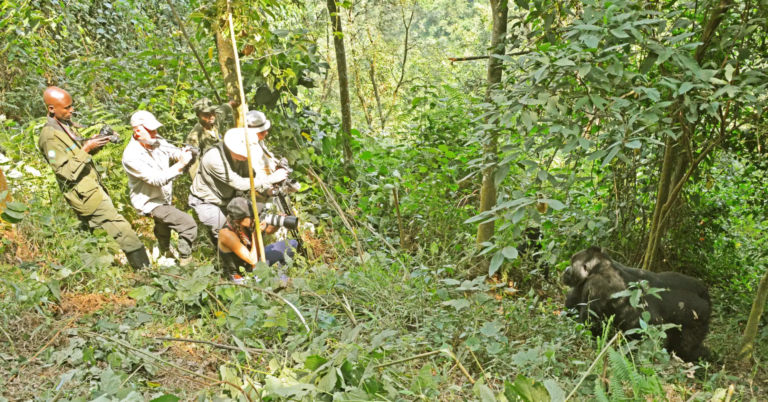
Tracking begins with an early forest walk guided by rangers who use the previous evening’s nest sites and the sound of calls to locate a community, followed by up to an hour observing them feed, groom and move through the canopy once found. Because chimpanzees travel faster and further than gorillas, a tracking morning can involve brisker, more unpredictable walking, and sightings, while very likely, are slightly less guaranteed than with habituated gorilla families.
Habituation experiences
Kibale and a handful of other sites also offer a chimpanzee habituation experience; a longer, small-group permit (typically up to four hours) that follows researchers and trackers working to habituate a community still becoming accustomed to human presence, offering a deeper, less time-boxed encounter than the standard one-hour permit.
Permits and planning
Chimpanzee tracking permits are significantly less expensive than gorilla trekking permits and considerably easier to secure on shorter notice, making chimpanzee tracking a natural addition to a gorilla trekking safari or a strong primate-focused safari in its own right, particularly when combined with birding or forest walks.
About chimpanzees
Chimpanzees are our closest living relatives, sharing about 98 percent of our DNA, and they live in large, fluid communities that split and rejoin through the day. They use tools, hunt together, form alliances and communicate with an elaborate range of calls, gestures and facial expressions. Spending time with them is lively, noisy and often moving, and it feels very different from the quiet encounter with mountain gorillas.
Chimpanzee tracking in Uganda
Uganda has the best chimpanzee tracking in East Africa. Kibale National Park, near Fort Portal, is the best known, with a high chance of finding habituated chimpanzees and a rich forest of other primates and birds. Budongo Forest, near Murchison Falls, offers a quieter experience, Kyambura Gorge in Queen Elizabeth National Park gives a dramatic setting, and Kalinzu Forest has its own habituated community. Ngamba Island Chimpanzee Sanctuary on Lake Victoria cares for rescued chimpanzees and is a good short stop from Entebbe.
Chimpanzee tracking in Rwanda and Tanzania
In Rwanda, Nyungwe National Park offers chimpanzee trekking in a vast, ancient mountain rainforest, with colobus monkeys, birds and the canopy walkway nearby. In Tanzania, Gombe Stream and Mahale Mountains national parks, on the shore of Lake Tanganyika, are remote and wild, with a long research history that began at Gombe in 1960. Both parks need extra travel time and are best on a dedicated trip.
Chimpanzee tracking versus gorilla trekking
Chimpanzees are fast, loud and mostly in the trees, so tracking can mean quick walking and moments of sudden action. Gorillas are calm and ground-dwelling, so the encounter is quiet and slow. Both give exceptional wildlife moments, and most travellers who visit Uganda or Rwanda do both. If you are choosing one, gorilla trekking is the headline, and chimpanzee tracking is the best companion.
The chimpanzee habituation experience
Habituation experiences take a small group into the forest for much longer than a standard tracking visit, giving time to watch a community that is still becoming used to people. They are physically demanding, need more time and need advance booking, but they are one of the deepest ways to understand how chimpanzees live. We arrange habituation experiences where they are available.
Best time for chimpanzee tracking
Chimpanzee tracking is possible all year. The drier months make forest paths easier, but sightings are generally good in any season. In fruit seasons chimpanzees are often high in fig trees and can be easier to find, so a good guide matters more than the calendar. See our gorilla permits and chimpanzee permits guides for booking details.
What to expect on a chimpanzee tracking day
You meet at the park headquarters for a briefing, then walk into the forest with a ranger and trackers who have located the community. Walks can be short or long depending on where the chimpanzees are feeding, and the terrain is usually gentler than a gorilla trek. Once you find them, you spend about an hour watching them feed, groom and play, often high in fruiting trees. Bring binoculars, a rain jacket and a camera that copes with low light.
Combining chimpanzees with the rest of Uganda
Kibale sits on the route between Murchison Falls and Queen Elizabeth, so chimpanzee tracking fits naturally into a classic Uganda circuit. It also pairs with the crater lakes near Fort Portal, the Bigodi wetland sanctuary for birds and monkeys and, further south, gorilla trekking in Bwindi. We design the route so that long drives are broken into comfortable stages.
Choosing between chimpanzee tracking and a gorilla trek
Many guests ask whether chimpanzee tracking can replace a gorilla trek. It cannot, but the two work well together. Chimpanzee tracking is usually cheaper, the permit is easier to secure at short notice and the walking is gentler, so it suits a longer itinerary with several primate days. See chimpanzee permits for the current rules and gorilla trekking for the bigger bucket-list encounter. Most of our guests book both, and we place them on separate days with a rest day between.
Plan your chimpanzee tracking safari
Tell us your travel dates and which forest interests you, and we’ll build the permits and route around it. Visit Plan My African Safari, message us on WhatsApp at +256 701 243 304, or email [email protected].