Why national parks don’t allow night drives
Uganda, Kenya and Tanzania’s government-run national parks generally restrict game drives to daylight hours, both for visitor safety and to limit disturbance to wildlife after dark. Private conservancies, operating under separate management arrangements outside the national park system, are able to set their own rules and frequently permit night drives as a distinct, additional activity.
Where night drives are offered
Kenya’s private conservancies, including Ol Pejeta and Lewa in Laikipia, are among the region’s most established night-drive destinations, using spotlights to find nocturnal species that daytime drives rarely encounter. Several conservancies bordering the Maasai Mara, rather than the reserve itself, also offer night drives under similar private management arrangements.
What you might see
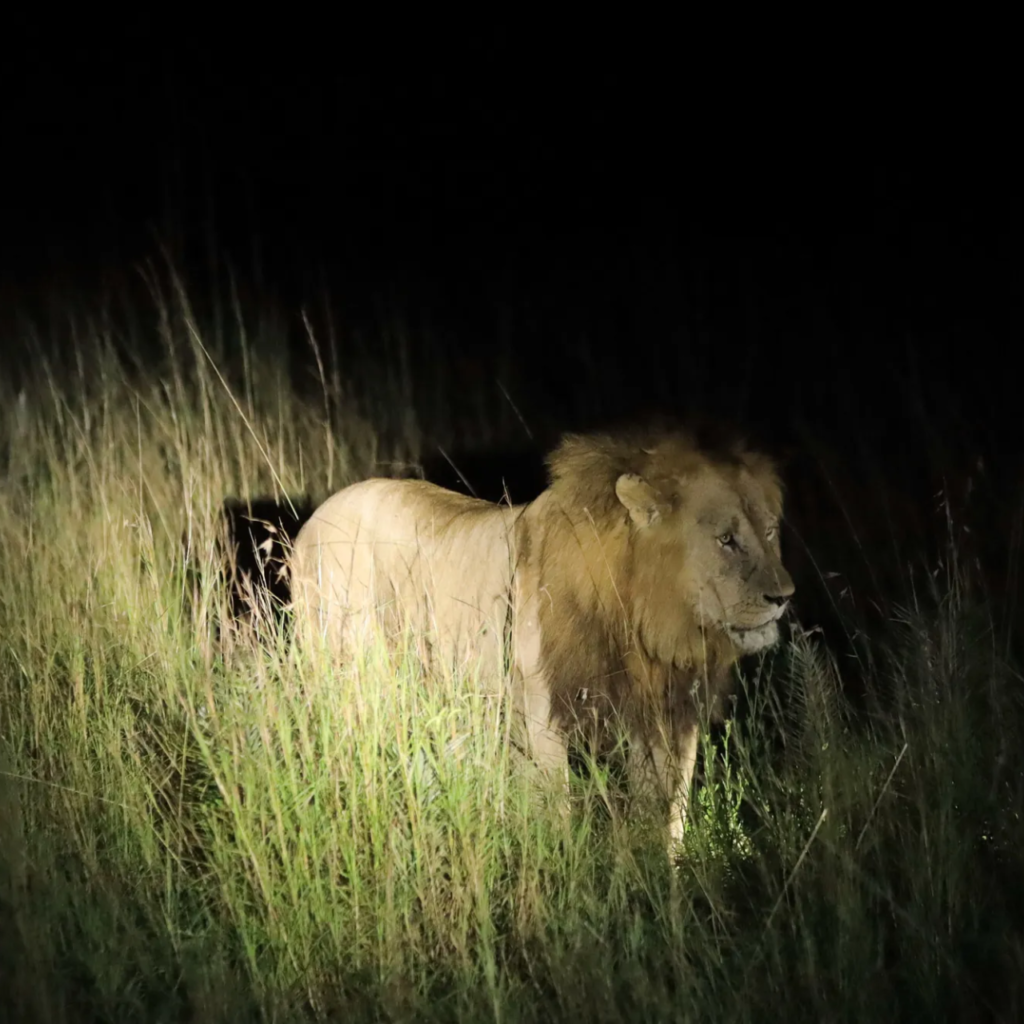
Night drives regularly turn up species that spend most of daylight hours hidden or resting: genets, civets, aardvarks, porcupines and, with good fortune, leopards and lions actively hunting rather than resting in shade as they typically do during the day. Spotted hyenas, more active by night than day, are also considerably more likely to be seen hunting or scavenging after dark than during a standard morning or afternoon drive.
How a night drive works
Night drives use a spotlight, operated by a guide or tracker, swept across the landscape to catch the reflective eyeshine of animals in the dark, a completely different search technique from the visual scanning a daytime drive relies on. Red-filtered lights are used by better conservancies specifically because they disturb nocturnal animals considerably less than plain white light, letting guests observe natural behaviour rather than an animal reacting to being lit up.
Combining night drives with daytime game drives
Most travellers add one or two night drives onto a conservancy stay that also includes standard daytime game drives, rather than replacing daytime activity entirely, since the two show different sides of the same landscape. A typical conservancy stay of three or four nights comfortably allows for both without feeling rushed.
Practical notes
- Warm clothing is essential, since temperatures drop noticeably after dark even close to the equator
- Photography is difficult in low light without specialist equipment; most visitors focus on watching rather than shooting
- Night drives typically run 90 minutes to two hours, usually after dinner
- Sightings are less predictable than daytime drives, since nocturnal wildlife covers more unpredictable ground in the dark
Night walks alongside night drives
Some conservancies also offer short guided night walks close to camp, a slower, quieter counterpart to a night drive, focused on smaller nocturnal creatures, insects and the sounds of the bush after dark rather than covering ground in search of larger animals. These are generally offered as a shorter add-on rather than a substitute for a full night drive, since the guided walking radius close to camp naturally covers less ground.
Safety and guide expertise
Night drives and walks are led by guides specifically trained for after-dark conditions, reading animal behaviour and maintaining safe vehicle or walking distances that differ meaningfully from daytime protocols, since reduced visibility changes how animals react to a vehicle or group’s presence. This specialised guiding is part of why night activities are generally only available through established conservancies with dedicated night-drive protocols rather than offered informally.
Best time to visit
Night drives run year-round wherever a conservancy offers them, since the activity depends on the conservancy’s own schedule rather than seasonal wildlife movement.
Star-gazing as a night activity
Many conservancies pair a night drive with time set aside for star-gazing once the vehicle stops in a suitably dark spot away from any camp lighting, taking advantage of the minimal light pollution across most of the region’s private conservancies. Some camps supplement this with a telescope and a guide familiar with the southern hemisphere’s constellations, adding a further dimension to an evening built around the dark rather than working around it.
What you can hear and feel
Night in the bush is full of sound. Frogs, insects, owls, nightjars and distant lions fill the darkness, and the air smells of earth and dust. Without the visual overload of daylight, your other senses sharpen, and even a short walk or drive feels like a new experience. Take time to turn off lights, stand still and listen.
Seeing the night shift
Many animals are more active after dark. Bushbabies, genets, civets, porcupines, honey badgers, aardvark and leopards all hunt or forage at night and spotlights reveal their eyes. The animals you see are different from those of the day, and that is part of the thrill. Guides know where to look and how to use lights so as not to disturb animals.
Planning your night out
Night activities are offered in specific places so we plan them when we build your route. They usually follow dinner or a late afternoon drive and last two to three hours. Dress warmly, because nights can be cold in open vehicles and bring a torch, insect repellent and a camera that handles low light. Book in advance, since vehicles and guides are limited.
Equipment and clothing
Dress in layers, with a warm jacket and a hat for the cold air and wear closed shoes. Carry a torch with a red filter if you have one, because red light disturbs animals less than white. A camera with a fast lens or high ISO capability is useful, but keep flash off, since it can startle wildlife. Insect repellent protects against mosquitoes.
Guides carry powerful spotlights and know how to use them sparingly. Follow their instructions, remain seated in the vehicle and keep your voice low.
A night to remember
Many travellers remember their night experience for a sighting that never happens in the day, such as a leopard crossing a track, a porcupine rummaging for roots or a bushbaby leaping through a tree. Others remember the sky, with the Milky Way spilling over the plains. Either way, the night adds a dimension to a safari, and a single outing is often enough to change how you feel about the bush.
Planning your night drive
Tell us if a private conservancy stay is part of your Kenya or Mara-area itinerary, and we will build in night drives alongside your standard daytime game viewing.