On a green hilltop in north-west Kampala stands a great dome of thatch, its roof sweeping almost to the ground, its doorway guarded by fire and by silence. This is the Muzibu Azaala Mpanga, the main house of the Kasubi Tombs, the burial ground of four kings of Buganda. It is one of the most sacred places in Uganda and one of only a handful of UNESCO World Heritage Sites in the country.
Kasubi is not a monument to a lost civilisation. It is a living royal enclosure, tended by clan elders and by the widows and descendants of the kabakas, and it is still the place where Baganda come to seek the blessing of their ancestors. To visit it with a knowledgeable guide is to step into the heart of the kingdom.
A palace that became a tomb
The site covers about 30 hectares of hillside in Kampala. At its centre is what was once the palace of the kabakas, built in 1882 by Kabaka Mutesa I and converted into a royal burial ground in 1884, after his death. Buganda’s tradition was that a king’s palace became his tomb, and each new king built a new palace elsewhere.
Four kabakas now lie in the Muzibu Azaala Mpanga:
- Mutesa I (reigned 1856 to 1884), the king who received Speke and Stanley.
- Mwanga II, the king of the Uganda Martyrs’ era, who died in exile.
- Daudi Chwa II, who reigned under the British protectorate.
- Edward Mutesa II, Uganda’s first president, who died in exile in London in 1969 and whose remains were returned to Uganda.
Alongside them are the tombs of other members of the royal family, and much of the site remains farmland, worked by traditional methods.
The building
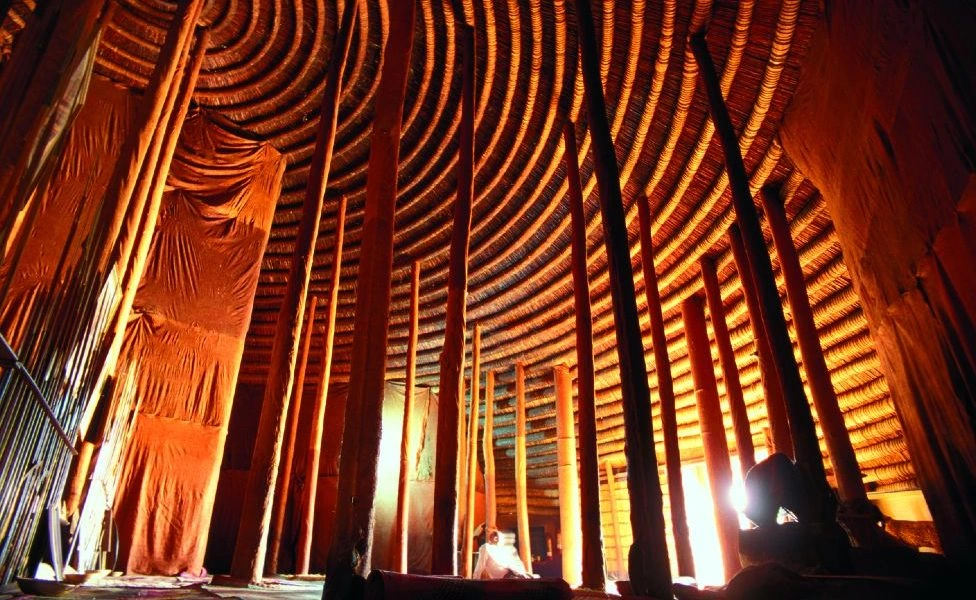
The Muzibu Azaala Mpanga is a circular building topped by a dome, about 31 metres across, made entirely of organic materials: a framework of wooden poles, reeds, wattle and daub, and a dense layer of thatch. It is a major example of architecture in natural materials, and UNESCO also values it as a symbol of belief, spirituality, continuity and identity.
Inside, the tombs are hidden behind curtains of bark cloth. Beyond them, according to tradition, lies “the forest”, a place where the king does not die but simply goes into the wild. Visitors are shown the entrance to the forest, and it is taboo to look beyond it. Every clan has a role in the building and its care, and each is represented in the structure, so the house is in a real sense the work of the whole kingdom.
Also at the site are the Bujjabukala, the great gatehouse, a museum of royal objects such as royal dress, weapons and hunting tools, and the compounds where the kabakas’ widows and the custodians of the tombs live.
Fire and rebuilding
On the evening of 16 March 2010, an unexplained fire destroyed the Muzibu Azaala Mpanga. The loss was felt across Uganda and beyond, and the site was placed on UNESCO’s List of World Heritage in Danger. Another fire damaged part of the complex in 2020.
What followed was one of the most remarkable heritage recoveries in Africa. The kingdom, the government, UNESCO and international partners, working with local craftspeople and clan custodians, rebuilt the main house using traditional techniques, restored the gatehouse and installed a modern fire-fighting system, including a large water tank and trained volunteer fire-fighters from the local community. In September 2023 the World Heritage Committee removed Kasubi from the Danger List. Reports say the site has reopened to visitors; opening arrangements and any ceremonial closures can change, so we confirm access before your visit.
What a visit is like
- You arrive at the outer gate and are met by a guide, often a custodian who is part of the royal household.
- You pass through the gatehouse and into the courtyard in front of the tombs, where you learn how the enclosure is organised.
- You enter the Muzibu Azaala Mpanga, removing shoes, and hear about each kabaka and the customs of the tombs.
- You may visit the museum, the shrines for other royals and the area where bark cloth is made.
Visits usually take one to two hours. Ask questions. The guides welcome them, and their answers are much of the value of the visit.
Etiquette
- Dress modestly, with shoulders and knees covered.
- Remove your shoes where asked, and lower your voice inside the tomb house.
- Photography is limited in some areas, and often not allowed inside the tomb house. Always ask.
- Do not touch objects, and never look beyond the entrance to the forest.
Getting there and timing
Kasubi is on Kasubi Hill in north-west Kampala, about 45 minutes to an hour from Entebbe airport in normal traffic and often longer at peak times. It combines well with the Bulange and Mengo Palace, the Uganda Museum and the cathedrals on the hills of Namirembe and Rubaga, all of which sit within a few kilometres. Mornings are cooler and quieter. Public holidays and royal ceremonies can affect access.
Visit Kasubi with Offmap Safaris
We include Kasubi in cultural days in Kampala, in longer Buganda heritage safaris and as an arrival or departure day around Entebbe. Your guide will explain the meaning behind what you see. Plan your safari, message us on WhatsApp +256 701 243 304 or email [email protected]. Please read our Responsible Travel page too.