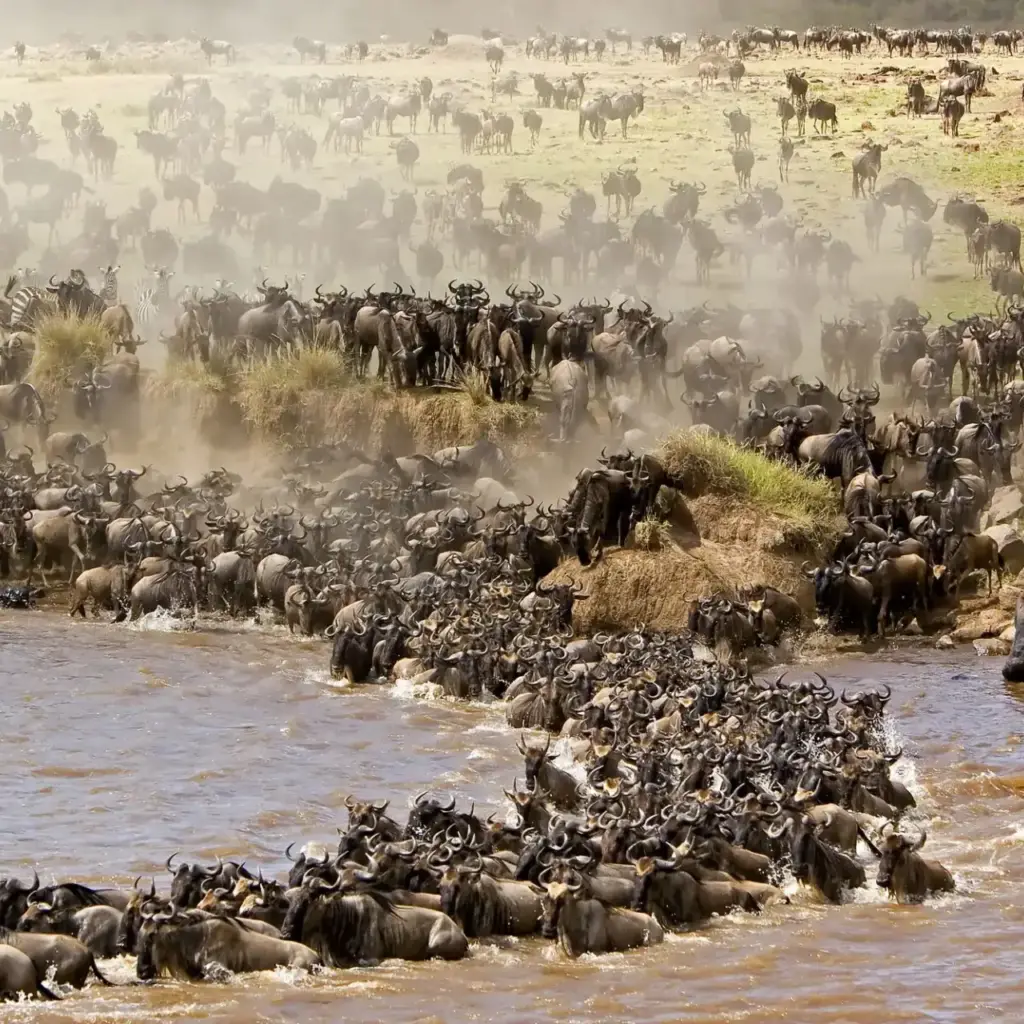
Of everything the Great Migration involves, one moment gets more attention than all the rest combined: a wall of wildebeest, suddenly committed, pouring down a riverbank into brown water that may be hiding a dozen waiting crocodiles. It lasts minutes. It is the reason most migration-season itineraries exist at all.
Why cross a dangerous river at all
The Mara River is not an obstacle the migration seeks out. It is simply in the way. Fresh grazing lies on the far bank, and the herd’s instinct to keep moving toward it eventually overrides its instinct to avoid the water. What follows is less a decision than a cascade: a handful of animals commit first, hesitating at the bank sometimes for hours, and once the first few finally jump, the thousands behind follow almost automatically, swept up in the same crowd logic that got them to the bank in the first place.
The crocodiles are waiting for exactly this
The Mara River’s Nile crocodiles are among the largest on the continent, and many spend much of the year fasting between migration seasons, relying on the crossings for a large share of their annual feeding. A Nile crocodile can lunge more than half its own body length out of the water to seize prey, and kills by dragging an animal under to drown rather than by a quick bite; one reason crossings can look, and are, genuinely brutal to watch.
Myth versus reality: how dangerous is a crossing, really?
It’s worth separating the drama of a crossing from the actual numbers. Across the full migration, around 250,000 wildebeest and 30,000 zebra die each year, but the majority of that mortality comes from predation away from the river, plus exhaustion, thirst and stampede injuries, not specifically from drowning or crocodile kills during crossings. The river crossing is the migration’s most photographed moment, not its leading cause of death; a useful piece of context for understanding what you’re actually watching.
Where and when crossings happen
Mara River crossings are most reliable from around July to October, as the migration moves through Kenya’s Maasai Mara, with several well-known crossing points along the river favoured by guides for visibility and access. A smaller-scale equivalent happens on Tanzania’s Grumeti River in the western Serengeti around May and June, with far fewer vehicles in attendance: covered on our Great Migration in Tanzania page.
What a crossing actually looks like
Herds often gather at the riverbank well before committing: sometimes for hours, occasionally turning back entirely if something spooks the lead animals. When a crossing does begin, it moves from stillness to total chaos almost instantly: hundreds of animals in the water at once, dust and spray, the distinctive grunting calls of the herd, and guides positioning vehicles well in advance since no one can predict the exact minute it will start. No crossing can ever be guaranteed on a fixed date (it is genuinely wild behaviour, not a scheduled performance) which is exactly why a guide who reads herd behaviour, not just a calendar, matters so much here.
Planning to see one
See our Great Migration in Kenya page for timing and where to stay, our Wildebeest page for the animal behind the spectacle, and our Accommodation in Kenya guide for camps positioned closest to the river itself.
Plan a safari around Mara River Crossings: The Minutes Everyone Talks About
Tell us your dates and what you most want to see, and we’ll time your safari to match it as closely as nature allows. Talk to us, or browse our safari packages to see how a migration-timed itinerary is put together.