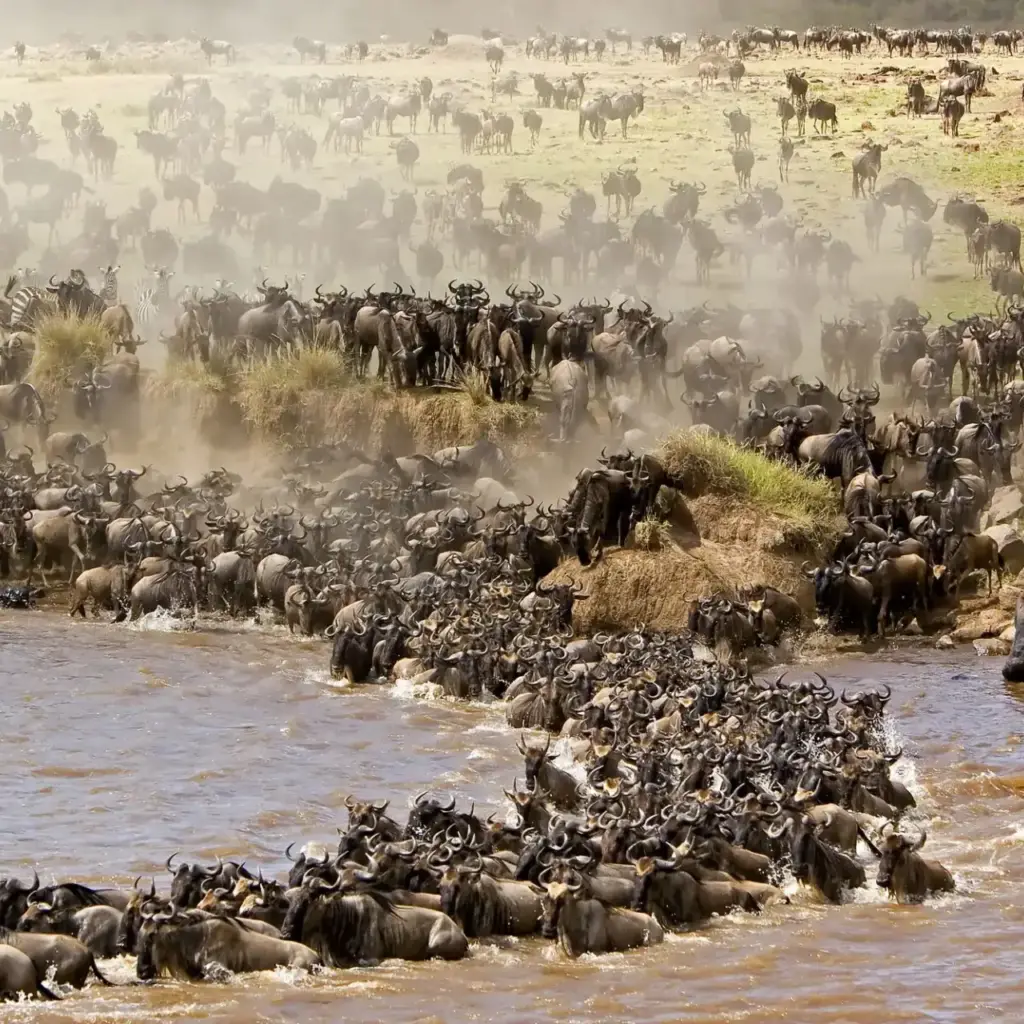
Up close, a wildebeest is an odd-looking animal; the front half of a heavily built ox, the hindquarters of an antelope, a beard, and a pair of curved horns worn by both males and females. Seen alone, it is easy to underestimate. Seen as one of 1.5 million moving across the Serengeti-Mara plains in a single connected herd, it becomes one of the most astonishing sights left in the natural world.
What exactly is a wildebeest?
Wildebeest are large antelope, weighing between 120 and 300kg, and go by two names almost interchangeably: “wildebeest,” from the Afrikaans for “wild beast,” and “gnu,” a name thought to imitate the deep, guttural call herds make almost constantly, especially during the May–June mating season when bulls bellow to hold territory. Two species exist; the blue wildebeest of East and Southern Africa, which makes up the Serengeti-Mara migration, and the smaller black wildebeest, confined to South Africa.
Built for a life on the move
Despite their bulk, wildebeest can run at speeds of up to 50mph (80km/h) in short bursts: fast enough to outrun most predators over a short distance, if not over the long, exposed crossing of a river. They are intensely social and rarely found alone, moving, grazing and resting in herds that can number in the hundreds of thousands, and relying on that sheer density as their main defence: for any individual predator, the odds of catching any one specific animal in a herd that size are vanishingly small.
The numbers behind the spectacle
- Around 1.5 million wildebeest take part in the Great Migration, alongside roughly 200,000 zebra and smaller numbers of gazelle and eland.
- The Serengeti’s wildebeest population alone eats more than 4,500 tonnes of grass a day; a scale of grazing pressure that shapes the entire ecosystem beneath it.
- The full migratory circuit covers 800 to 1,600km a year, depending on the rains, as herds move between Tanzania’s southern Serengeti plains and Kenya’s Maasai Mara and back again.
- About 80% of all wildebeest calves are born within the same two-to-three-week window each year; a deliberate flood-the-market strategy against predators, covered in full on our Great Migration in Tanzania page.
A population that almost didn’t make it
The migration as it exists today is younger than most visitors assume. Through the first half of the twentieth century, rinderpest, a viral cattle disease that also infected wildebeest, kept the population suppressed at around 200,000 animals. When a cattle vaccination campaign eliminated rinderpest from the region by the early 1960s, the wildebeest population was freed to recover, and it did so dramatically: by the late 1970s, numbers had climbed to roughly 1.5 million, close to where they remain today. The scale of the modern migration is, in a real sense, a side effect of veterinary science rather than an ancient, unchanging constant.
Where to see them
Wildebeest are present year-round across the Serengeti-Mara ecosystem, but where the main herd actually is changes by season. See our Great Migration in Kenya and Great Migration in Tanzania pages for exactly when and where, and our Mara River Crossings page for the single moment most visitors are hoping to witness.
Plan a safari around The Wildebeest: Meet the Animal Behind the Greatest Show on Earth
Tell us your dates and what you most want to see, and we’ll time your safari to match it as closely as nature allows. Talk to us, or browse our safari packages to see how a migration-timed itinerary is put together.